

It is likely not necessary for art to be revolutionary in order for it to be valuable. Likewise, it may not be the case that all revolutionary art is necessarily good art. It is not clear if art can be (or, alternatively, can still be) revolutionary. To be clear, under the cultural conditions of late stage capitalism—the conditions Mark Fisher defines as Capitalist Realism—the role of art, and the role of art which engages with transgressive rhetoric in particular, has fundamentally changed to such an extent that it is necessary to question if art can still be revolutionary. The fundamental problem with art under capitalist realism is that it can perform our anti-capitalism for us allowing us to consume guilt-free. The illusion of capitalism is no longer to obscure ideology, but to make us think our ideological convictions are what count rather than our cooperation. As such, it is also important to consider how art functions as what Louis Althusser calls an Ideological State Apparatus. I intend to show that art does have the capacity for revolution, that art can engage with the alternative which is obfuscated by capitalist realism, and that it does so by radically “grasping at the root.”
Bleu Cheesemongers: Proletariat Emancipation in Marx
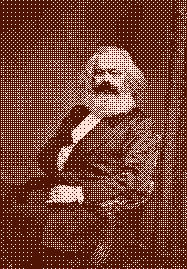
In Karl Marx’s introduction to the incomplete work Contribution to the Critique of Hegel’s Philosophy of Right, he states that
“It is clear that the arms of criticism cannot replace the criticism of arms. Material force can only be overthrown by material force; but theory itself becomes a material force when it has seized the masses. Theory is capable of seizing the masses when it demonstrates ad hominem, and it demonstrates ad hominem as soon as it becomes radical. To be radical is to grasp things by the root. But for man the root is man himself.”
In this passage, Marx is laying out the framework for the emancipation of the proletariat. Though theory cannot directly overpower material force, theory can become a material force. It does so by seizing the masses, the masses being the proletariat. To seize the masses, it is not enough to argue rationally; one must demonstrate ad hominem to indicate the material effects of ideology.
Throughout the text, Marx refers to the religious history of Germany, including Protestantism and German Idealism’s negation of religiosity; this is an attempt to anticipate the development and response to ideology. The protestant revolution was one toward the theoretical or the ideological. The monk supposedly “liberated man from external religiosity by making religiosity the innermost essence of man” and, though not necessarily a solution, “it did at least pose the problem correctly. It was no longer a question, thereafter, of the layman’s struggle against the priest outside himself, but of his struggle against his own internal priest, against his own priestly nature.” Here, Marx demonstrates what exactly he meant by “theory itself becom[ing] a material force when it has seized the masses” in that the power of the priest’s ideas are not the ideas-in-themselves but rather how this idea has been internalized. For instance, if at Sunday mass the priest tells the congregation that “bleu cheese is an abomination and one should only eat old fort cheddar,” there is no immediate power in that idea; bleu cheese stock prices will not crumble. Unless it seizes the minds of the congregation who no longer purchase bleu cheese.
Marx, very unusually, advocates for ad hominem to be used. Typically, ad hominem is a fallacy which devalues an argument on the basis of one’s character. However, the way Marx intends it is for us not to get caught in the space of purely rational and ideological debate and instead consider the root material cause of ideology. For instance, let us say that the priest’s argument about cheese is both valid and sound; that the priest has derived all of this from religious scripture and, uncharacteristically of priests, has even done the necessary scientific research to justify his claim. However, suppose we were to find out that the priest’s brother was a cheesemonger specializing in cheddar while his rival focused on bleu cheese. In that case, why he may push this becomes clear. It is not out of the pursuit of truth but to reinforce his position in society. Thus we can begin to attack his argument ad hominem. To Marx, “man is not an abstract being squatting outside the world” and it is “man [who] makes religion [or ideology]; religion [or ideology] does not make man.” Therefore, to attack ad hominem is not necessarily to attack fallaciously but to understand that these ideologies come from a material basis. Marx is not advocating for us to argue ad hominem at all times. Suppose the priest then argues that murder is wrong without the intention of dissuading the bleu cheesemonger’s retaliation. That does not mean we should discard the conclusion merely because it came from the priest’s mouth.
When Marx refers to grasping by the root, he is making it clear that to be radical one must be material, which is to say that a rational critique of ideology is not enough. Instead, one must understand the historical and material roots of the ideology in question. Even with our cheddar priest, it is not enough to realize that he benefits from it; it must be put into an even broader context to be seized by the roots. The priest belongs to a broader historical and material context; it is not just that his brother has a vested interest in cheddar cheese, but that he is under a capitalist system, owns the means of production, and exploits the labour-power of others, that he even has the ability to profit.
Marx marks a division between two types of revolution a “radical revolution… [or a] merely political revolution.” In short, the key difference between the two revolutions is the universality of said revolution. In other words, they are differentiated by whether or not there is a class fracturing. In the merely political revolution, it is only “a section of civil society” which liberates itself and “society as a whole, but only on condition that the whole of society is in the same situation as this class.” In our case, this would be as if the bleu cheesemongers had enough and revolted against the cheddar conglomerate and their priest. These bleu cheesemongers are not necessarily fighting to emancipate any and all cheesemongers, but merely their class of cheesemongers from oppression. In doing so, the bleu cheesemongers “at the very moment when [they] begin [their] struggle against the class above [them], [they] remain involved in a struggle against the class beneath.”
In contrast, the radical revolution, by necessity, must be universal, must not fracture the oppressed class, and therefore has to be a revolution of the proletariat. The proletariat is a class which has “radical chains” and is “a class which is the dissolution of all classes… which has a universal character because its sufferings are universal.” This revolution cannot just be the blue cheesemonger’s response to a “particular wrong but [rather] wrong in general.” The proletariat revolution must, by definition of the proletariat, be one which includes all oppressed classes. This includes the swiss cheesemonger, the cheesemongers’ wives whose household labour is exploited and unnoticed, the rancher whose animals supply milk for the cheesemonger conglomerate, the farmer whose grain feeds the rancher’s cattle, et cetera. Rather than fracture the bleu cheesemonger from the rest of the proletariat, there is a “dissolution of society, as a particular class, [which] is the proletariat.”
To inspire this radical proletariat revolution, it must be demonstrated ad hominem that the ideologies they have espoused from priests and cheddar capitalists have been spread in order to benefit the ruling class. This is because, as has been shown, ideology cannot overthrow a material force unless it has seized the masses. By the masses, Marx means the totality of the proletariat. The only way to seize the proletariat is to demonstrate ad hominem who benefits from the ideology.
ISA—CIA—MFA

Althusser conceives of the functions of the Ideological State Apparatus as being to “reproduce: 1. the productive forces, 2. the existing relations of production.” That is to say, to uphold a system of production, there must be a force which maintains it both materially and ideologically. He notes that “it is in the forms and under the forms of ideological subjection that provision is made for the reproduction of the skills of labour power.” ISAs are not merely educational systems, they can include “the religious… the family… the legal… the political… the trade-union… the communications… [and most relevant for our case] the cultural ISA (Literature, the Arts, sports, etc.).”
One of the most common pieces of creative writing advice that still gets thrown around to this day is to “show, don’t tell.” That is to say, when writing, it is generally better not to say “I am sad” but to imply that one is sad by, for instance, the swelling of the eyes. The thing many are not aware of, however, is that this very piece of writing advice comes from a CIA intervention into MFA programs in order to depoliticize any radical notions prevailing in art. The most influential American creative writing program was the Iowa Writers’ Workshop, which was funded through The Farfield Foundation, which “was not really a foundation; it was a CIA front that supported cultural operations.” Enforcing this “show, don’t tell” mentality meant that any political meaning was obscured. This was particularly important in that the Iowa Writer’s Workshop was a response to the Soviet Union offering free university. “Through the University of Iowa, Engle [the director of Iowa Writer’s Workshop] received $10,000 to travel in Asia and Europe to recruit young writers—left-leaning intellectuals—to send to the United States on fellowship.” Engle realized “that the postwar era belonged to institutions. The unit of power was no longer the great man but the vast bureaucracy.” In other words, to the ideological state apparatus. The type of writing which these workshops engaged in are exemplified quite well as follows:
Since the 1980s, the textbook most widely assigned in American creative-writing classes has been Janet Burroway’s Writing Fiction. Early editions… dared students to go ahead and try to write a story based on intellectual content—a political, religious, scientific, or moral idea—rather than the senses and contingent experience. Such a project “is likely to produce a bad story. If it produces a bad story, it will be invaluably instructive to you, and you will be relieved of the onus of ever doing it again. If it produces a good story, then you have done something else, something more, and something more original than the assignment asks for.” The logic is impeccably circular: If you proceed from an idea, you’ll write a bad story; if the story’s good, you weren’t proceeding from an idea, even if you thought you were.
The ideology behind these programs praised works which view “Life [as] recalcitrant because it resisted our best efforts to reduce it to intellectual abstractions, to ideas, to ideologies.” This focus away from art which is inherently ideological shows how art has, in the past, functioned as an Ideological State Appartus—the problem with this today is that art need not function in this same way. To these Writer’s Workshops, if an idea or concept was displayed in a work it was a byproduct of the concrete rather than the concrete being a representation of this idea. This functions in reverse to how theory can, according to Marx, become radical. That is to say, rather than taking an idea and demonstrating it Ad Hominem through writing, the Writer’s Workshops are more mimicking the natural material production of ideology.
Art as Ad Hominem

The TV series The Boys is a compelling critique of capitalism. It takes on the mythology of the American superhero as a means of fostering said critique by depicting a world in which the superhero is a corporate entity. It does so quite explicitly. The Boys does not hesitate to draw connections between literal nazis and capitalist ideology. One of the ways in which The Boys engages with capitalism more subtly is the ever-shifting role of the villain in the show. There are a few constants, such as the corporation Vought International and their figurehead superhero Homelander, but it is an abstracted entity. There are at times faces which come to represent Vought, but they are killed off or interchanged in political-bureaucratic moves. The corporate workers comprise Vought, the politicians who enable Vought, the superheroes who make up the team the Seven of Vought, are all consistently interchanged. As such, it engages with capitalism in the abstract; the villain is not one exploitative company but the system which allows exploitation at large.
No matter how well the show achieves this aim, one cannot ignore the fact that the show is produced by Amazon. This is the fundamental difference of the ad hominem that Marx advocated for versus what we are faced with today: there is no longer a necessary tangible link between the ideology and the ad hominem behind the ideology. That is to say, “Far from undermining capitalist realism, this gestural anti-capitalism actually reinforces it.” One could certainly make the case that The Boys engages with anti-revolutionary rhetoric—particularly in the mirroring of Billy Butcher, the revolutionary, and Homelander, the psychopathic-superman—and, while I am inclined to disagree with this reading, it nevertheless does not matter. That is to say, the function of anti-capitalist art in a capitalist system need not undermine itself; rather, there is an “‘interpassivity’: the film [or TV show] performs our anti-capitalism for us, allowing us to continue to consume with impunity.” It allows me to sit down on an Ikea couch with a case of Miller Lite to open Amazon Prime to watch The Boys. As such, “The role of capitalist ideology is not to make an explicit case for something in the way that propaganda does, but to conceal the fact that the operations of capital do not depend on any sort of subjectively assumed belief.” Though I absolutely do not agree with the labour practices that have brought me to consume, I consume nevertheless.
This shows why I disagree with The Boys being anti-revolutionary. When Billy Butcher takes the drug compound V which has created superheroes, he is engaging with consumption in the same way we do. According to Fisher, “To reclaim a real political agency means first of all accepting our insertion at the level of desire in the remorseless meat-grinder of Capital.” That is to say, it is not enough to live at this level of dissonance; one does not have political agency by merely disagreeing with the consumption they engage in. On the other hand, one cannot simply stop consuming either. It is a necessity to survive. If one is to move to a hippie commune, even if they manage self-sufficiency, they are thereby disengaging with their political agency. Billy Butcher’s consumption of compound V is not a passive consumption which he does with the recompense of interpassivity, but instead he takes compound V to fuel his revolutionary aims.

What is thus necessary is for art to function ad hominem. The experimental hip hop group clipping. engages with Marxian materialism in a concrete way. For instance, their song, “Blood of the Fang,” engages with black revolutionary ideology in the lived bodily experience; which is to say, in this case, with a cognizance of death. There is a tension in that “Skin do show you who kin; that’s it though / [whereas] What’s inside never been too simple.” That is, the material condition of one’s existence is at odds at times with the ideological circumstances. The pre-choruses repeat this material and ideological tensions. First beginning with: “Queen Angela done told y’all ‘Grasp at the root’ / So what y’all talkin’ ‘bout ‘hands up don’t shoot’?” Here, clipping. is referencing Angela Davis who quotes Marx in saying that “Radical simply means ‘grasping at the root.’” clipping. is, in essence, advocating for a violent response to the violence committed against Black Americans. clipping. is saying that what is ideological must become material in order for it to be revolutionary. Which leads directly into the chorus’s engagement with violence committed against black Americans “Look back, blood on the ground … Look straight, they still shootin’” and concluding with “Now, what that tell you ‘bout death? / Death ain’t shit.” This conclusion is reached because “You was born to be a martyr / And it doesn’t really mean a thing because that body really meat… [and] your history is one you might consider killing for.” clipping. instantiates the ideological in the material at its most visceral; that is, in the bodily. Not only is it that one should respond materially and perhaps violently to their oppression, but that one’s oppression is material and violent. Fisher says that “The most Gothic description of Capital is also the most accurate. Capital is an abstract parasite, an insatiable vampire and zombie-maker; but the living flesh it converts into dead labour is ours, and the zombies it makes are us.” clipping. is acutely aware of this fact. The song engages with vampiric imagery throughout. The pain of black folk “is deep and ingrained in (Blood).”
Afro-Surrealism as Revolutionary

One of the best examples of the power of the ISA is in Boots Riley’s 2018 film Sorry to Bother You. When the protagonist, Cassius ‘Cash’ Green, is offered a promotion amidst a trade union strike, there is a brief moment during his hesitancy where he pictures the football team from his high school cheering him on. Here, Riley is showing that the function of the high school hierarchical structures is to reproduce the power structures of the so-called “rat race.”
Mark Fisher notes that the call centre is indicative of “the political phenomenology of late capitalism.” That it unearths how “As a consumer in late capitalism, you increasingly exist in two distinct realities.” Sorry to Bother You exists in a surreal version of this bureaucratic state. One could argue the movie, at least to begin with, takes place in the political phenomenology of capitalist mythology. It exists in a world where there is only the former distinct reality. Where not only do call centres work, but they work so well that the political elite utilize them to facilitate a neo-slave-trade. Cash does his job so well that he climbs the ranks of the corporate ladder to become a so-called “power caller.” Cash is representative of the consumer in late capitalism that Fisher describes. That is, he is self-aware of the evils in capitalism and this allows him to freely engage in it. Cash accepts the promotion to power caller amidst the trade union strike out of some notion of “self-interest.” There is a part of Cash which wants to accept this notion of capitalism: that he can go from “really needing this job” to “pulling himself up by the bootstraps.”
It is no accident that the art movement I have chosen to express as one which can be revolutionary under capitalist realism is the surreal. There is something transgressive in Afro-Surrealism. Afro-Surrealism is distinct from surrealism. The Afrosurreal Manifesto quotes Jean-Paul Sartre as saying African Surrealism “is revolutionary because it is surrealist, but itself is surrealist because it is black.” But Sartre is only partially right here. Surrealism in itself is not necessarily revolutionary. What makes Afro-Surrealism revolutionary is that its surrealism is rooted in the material lived conditions of the marginalized individual. That “Afro-Surrealism sees that all ‘others’ who create from their actual, lived experience are surrealist, per Frida Kahlo.” Here, Miller refers to Frida Kahlo because he opens the Manifesto with a quote from her which says “I’m not a surrealist. I just paint what I see.” One might also conceive of this as a demonstration ad hominem in the Marxian sense.
The second of the ten listed rules of the Afrosurreal Manifesto is as follows:
Afro-Surreal presupposes that beyond this visible world, there is an invisible world striving to manifest, and it is our job to uncover it. Like the African Surrealists, Afro-Surrealists recognize that nature (including human nature) generates more surreal experiences than any other process could hope to produce.
What is significant here is how afrosurrealism functions in opposition to surrealism. Whereas the surrealist must rely on dreams or hallucinogenics to come to an understanding of surreal logic, the marginalized individual, be they Black, Hispanic, Asian, Indigenous, Women, Queer, et cetera, have an understanding of this surreal logic inherently. “The Afrosurrealist Manifesto” makes it clear that this is not an African-American movement alone, that it “is fluid, filled with aliases and census-defying classifications… Afro-Surrealists are ambiguous.” They say that “Only through the mixing, melding, and cross-conversion of these supposed classifications can there be hope for liberation.” Just as Marx describes the proletariat as a class which has “radical chains” and is “a class which is the dissolution of all classes… which has a universal character because its sufferings are universal.” So too does the Afro-Surrealist have a universal character: they are “intersexed, Afro-Asiatic, Afro-Cuban, mystic, silly, and profound” as a way of “reject[ing] the quiet servitude that characterizes existing roles for African Americans, Asian Americans, Latinos, women and queer folk”; by being “Ambiguous as Prince, black as Fanon, literary as Reed, dandy as André Leon Tally, the Afro-surrealist seeks definition in the absurdity of a ‘post-racial’ world.” As such, the Afro-surrealist avoids the fracturing of classes along racial or gendered lines. The movement is not a response to a “particular wrong but [rather] wrong in general.” The Afro-surrealist is thus concerned with “the collective unconsciousness as it manifests in these dreams called culture.”
This “invisible world striving to manifest” is the world obscured by capitalist realism. Of note is the distinction between Afro-Surrealism and Afro-Futurism: whereas Afro-Futurism “turns to science, technology, and science fiction to speculate on black possibilities in the future. Afro-surrealism is about the present.” To the Afro-Surrealist, “The future has been around so long it is now the past.” and they “expose this from a ‘future-past’ called RIGHT NOW.” That is to say, the revolutionary possibility exists in the present. It is this aforementioned invisible world which coexists with the visible world.
Conclusion
Art can be revolutionary, but it is not enough for art to be critical for it to qualify as revolutionary. This is because, just as art can be revolutionary, it can be counter/anti-revolutionary; art need not function as propaganda to do so, in-fact, some of the most well constructed critiques of capitalism also function to reinforce capitalist realism. In order for art to go beyond mere critique, it must engage ad hominem or it must engage with the alternative to capitalism. This is precisely why Afro-Surrealism functions as revolutionarily.
Works Cited
Althusser, Louis. “Ideology and Ideological State Apparatuses.” in Lenin and Philosophy and Other Essays. Translated by Ben Brewster. Monthly Review Press, 1971.
Bennett, Eric. “How Iowa Flattened Literature.” The Chronicle of Higher Education. Accessed at chronicle.com/article/how-iowa-flattened-literature/?cid=gen_sign_in December 16, 2022.
Fisher, Mark. Capitalist Realism. Zero Books, John Hunt Publishing, Hampshire, UK, 2009.
Marx, Karl. “Contribution to the Critique of Hegel’s Philosophy of Right: Introduction.” in The Marx-Engels Reader. Edited by Robert C. Tucker. W. W. Norton and Company, Inc. New York, New York.
Miller, D. Scot. “Afrosurreal Manifesto.” FoundSF Digital Archive. Accessed at https://www.foundsf.org/index.php?title=Afrosurreal_Manifesto December 16, 2022.
 Caleb J. Browne